.jpg)
Issoria lathonia Linn.
The Queen of Spain Fritillary is a very scarce immigrant species in the UK, with most of the records coming from the coastal areas of Southern and Eastern England. It is resident in North Africa, most of mainland Europe, and also the southern parts of Sweden and Finland. More particularly, from a Sussex perspective, it breeds on the coastal sand dunes of Northern France, Belgium and The Netherlands, all of which are just a short flight across The English Channel, or southern North Sea.
Whilst primarily a migrant species, there have been two occasions in this millennium where it has been a transient resident, in Sussex; Chichester area, 2009 and Piddinghoe in 2017.
In total, there have been around 50 Sussex records, but many of those were from Victorian times, and as some of the specimens were bought at auction houses (for very high prices), the whiff of fraudulent practices was ever present. Fast forward to the second half of the 20th century and this species was extraordinarily rare, with just a single record between 1950 and 2006, at Worthing, on 24/09/1969.
That all changed, in 2007, when there was a mini-invasion of these butterflies. Moving west to east and including a single Hampshire record: Old Winchester Hill, June 13th, Southbourne April 29th, Kingley Vale, September 27th, Springhead Hill, April 18th and Friston Forest, September 25th. The ID books tell us that most records for this species are from July to October, and whilst that is absolutely correct, there have been records outside these months (as the listed dates above, show), and it’s always best to keep an open mind about a possible record, even if it appears to be “out of season”.
In 2008, an exhausted individual was found at Brandy Hole Copse, Chichester, on September 15th, but sadly it died the following day. In 2009, at the same location there was a sighting on July 14th, which was followed by records for eight different individuals, seen between September 22nd and October 15th. Collating the records for the Chichester area for the years 2007-2009, the conclusion was reached that this was the first-ever confirmed breeding colony of Queen of Spain, in Sussex.
There was a rather more transient colony at Piddinghoe in 2017. Dave Harris observed one nectaring on knapweed on August 26th and this prompted an extensive search by Dave Harris, Neil Hulme and Mark Cadey, the following day, when three males were found, one in good condition, and two others that were rather worn. These three males were seen on many dates until September 9th, and then much later, a new lone female was seen at the same location on October 27th.
Since 2017, there have been singles at North Marden 15/08/2019 and Green Ridge, Hove on 12/08/2022.
The narrative above provides a very brief history of the Queen of Spain records in Sussex but what about the butterfly species, itself.
Queen of Spain has three broods (and occasionally four) in its Mediterranean stronghold, but in northern Europe it is more usually double-brooded. It seems to enjoy hot, dry, dusty conditions and may be found in wildflower meadows, arable field margins, waste land, rocky slopes and similar habitats. In Sussex, the preferred larval foodplant, appears to be Field Pansy, a common native plant found on chalk and other light soils, such as Wealden Greensand. Wild Pansy is too rare in Sussex for it to play a significant role, but all violet species could be used, which means Hairy Violet on downland and Common Dog-violet, elsewhere. Borage is also mentioned by some authors, and whilst this is a non-native plant, it can be found on agricultural headlands as part of the seed mixes that are often used.
The adult butterflies are particularly fond of the nectar of thistles and knapweeds, and these plants are widespread and common on the South Downs.
What does this butterfly look like? Quoting Neil Hulme from The Sussex Butterfly Report 2009: “This medium-size butterfly is distinguished by the occurrence of large, metallic-silver spangles on the underside of the hind wings. The upper surface is a ginger-brown colour, decorated with a quite variable pattern of black spots. The wing profile is also characteristic, giving an unusual “squared off” appearance to the hind margins”.
The usual confusion species is Wall Brown, and sometimes Dark Green Fritillary. Since the very best butterfly enthusiasts may be momentarily puzzled, it’s always worth double- checking any butterfly on a downland track that is orange-brown or ginger-brown. It is highly likely that this species is considerably under-recorded.
As for the future, will be the Queen of Spain become a more common sight in Sussex. Some say that our winters are too damp, and some say they are too cold for this species to survive. The obvious riposte is that the Netherlands coast must be rather damp in the winter, and the winters in southern Sweden and Finland must be rather cold!
With a warming climate, we are witnessing some rather dramatic changes in our insect populations. More-or-less annually a new species of moth/hoverfly/solitary bee is added to the list of insects that now reside in the UK. If we assume that Field Pansy holds the key to Queen of Spain becoming established on the South Downs, then the wildflower headlands that surround many of the arable fields (especially on the gaming estates) are likely to provide the right type of habitat for this butterfly species.
Potentially, anywhere we might find Field Pansy. This native wildflower is common and widespread on the Coastal Plain, the South Downs and on Wealden Greensand. Find the larval foodplant, find the butterfly.
Photo by Neil Hulme
.jpg)
Photo by Neil Hulme
 Piddinghoe 27.8.17.jpg)
Photo by Neil Hulme
 Piddinghoe 27.8.17.jpg)
Photo by Neil Hulme
.jpg)
Photo by Neil Hulme
.jpg)
Photo by Neil Hulme
.JPG)
Photo by Dave Brown
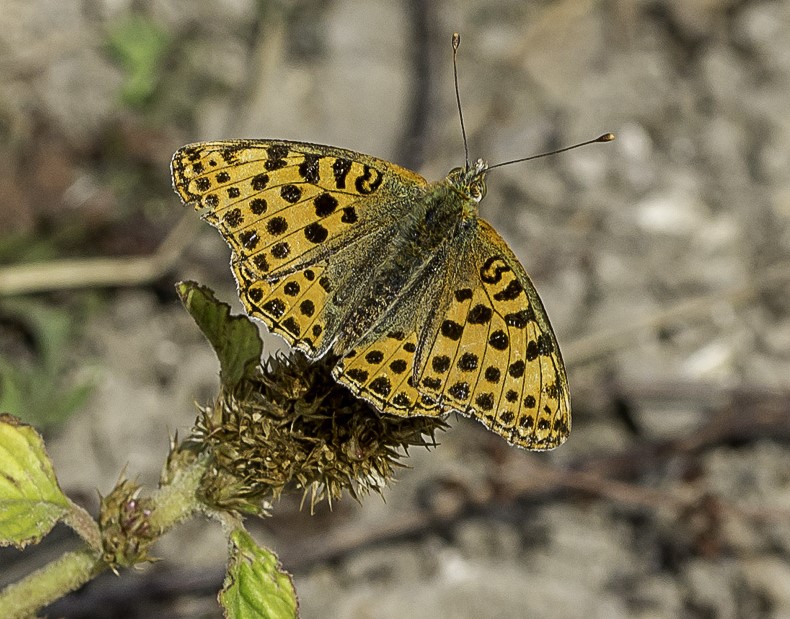
Photo by Pete Varnham
 - Copy.jpg)
Photo by Bob Eade
UK Butterflies Queen of Spain