It’s easy enough to confuse Large Whites and Small Whites. It’s easy enough to confuse Small Whites and Green-veined Whites. In a woodland ride, that small white butterfly could be a Small White, Green-veined White, female Orange-tip, or a Wood White. It’s all a bit confusing, isn’t it?
What has prompted this ID guide is the Wood White project that will begin in the spring of 2026. It’s a woodland survey, organised by David Bridges and Alan Birch, to try and locate all the Wood White colonies in West Sussex. We hope that many members will step forward and volunteer to look for these dainty woodland whites.
White butterflies are a bit tricky. Not only are there close similarities between species, but we also have two additional problems: for each species, the males and females have different markings, and these markings, and colours, are often slightly different between the first brood and the second brood.
Reading about all these differences you might be tempted to quit this article and go and watch some TV, but I can assure you the following photographs and text will make things a lot clearer, so do please persevere. The mysteries of the white butterflies will be soon de-bunked!
The Large White is a common butterfly in Sussex. It is a resident species, but it is also a regular migrant, which supplements its numbers in late summer.
As its name suggests, it is usually a large butterfly, and it has a languid, powerful flight with quite slow flaps of the wings. The male flies around the countryside looking for a female, and then the “mated female” flies around the countryside looking for suitable larval foodplants, which in the context of north-west Sussex woodland is usually Garlic Mustard. This butterfly species always seems to be on the move, here one moment and then gone the next. Hang on to that thought for when we get to the Wood White description.
Size is not everything, for some Large Whites can be small, and some Small Whites can be rather large. Even female Green-veined Whites can sometimes reach the size of a Large White, so whilst size is a useful starting point to a white butterfly’s identification, we still have to look at all the other characteristics. The uppersides of a Large White are a brilliant white, and this contrasts dramatically with the black markings on the forewings. Both sexes have a large black patch on the tips of the forewings and this black extends along the leading edge, and the rear edge, of the forewings.
Female Large Whites are very distinctive as they have two very large and very obvious black markings in the middle of the upperside forewings. The male is easily identified as it has no black dots on the upperside forewings. The undersides of the two sexes are similar, and both have black markings on the underside of the forewings.
Let’s look at some photos to make sense of it all.
Female Large White |
|
|---|---|
This is a large impressive butterfly. OK, it may be just white and black, but it certainly makes a bold statement. The background white is a “brilliant white” (especially the upperside hindwing) and the black markings are a very solid black. This statement applies to fresh individuals and with age the dense black markings will fade to dark grey. This female shows the typical two very large and very obvious black markings in the middle of the upperside forewings. Another ID feature of a Large White is the extensive “speckled grey/black” on the leading edge of the forewing, adjacent to the body. The key difference between a Large White and a Small White is the extent of the black patch on the tip of the forewing. Large Whites have a black patch that covers the tip of the forewing, but this black also extends well along the leading edge, and at least half of the rear edge of the forewing. Small Whites have a small grey/black patch which is confined to the wing tip. |
|
Male Large White |
|
|---|---|
Male Large Whites are usually less heavily marked, compared to the females, but the main point of difference is the absence of black dots of the upperside forewings. This means that the "brilliant white" shows even better, as in this photograph. The markings are otherwise very similar for the two sexes. |
|
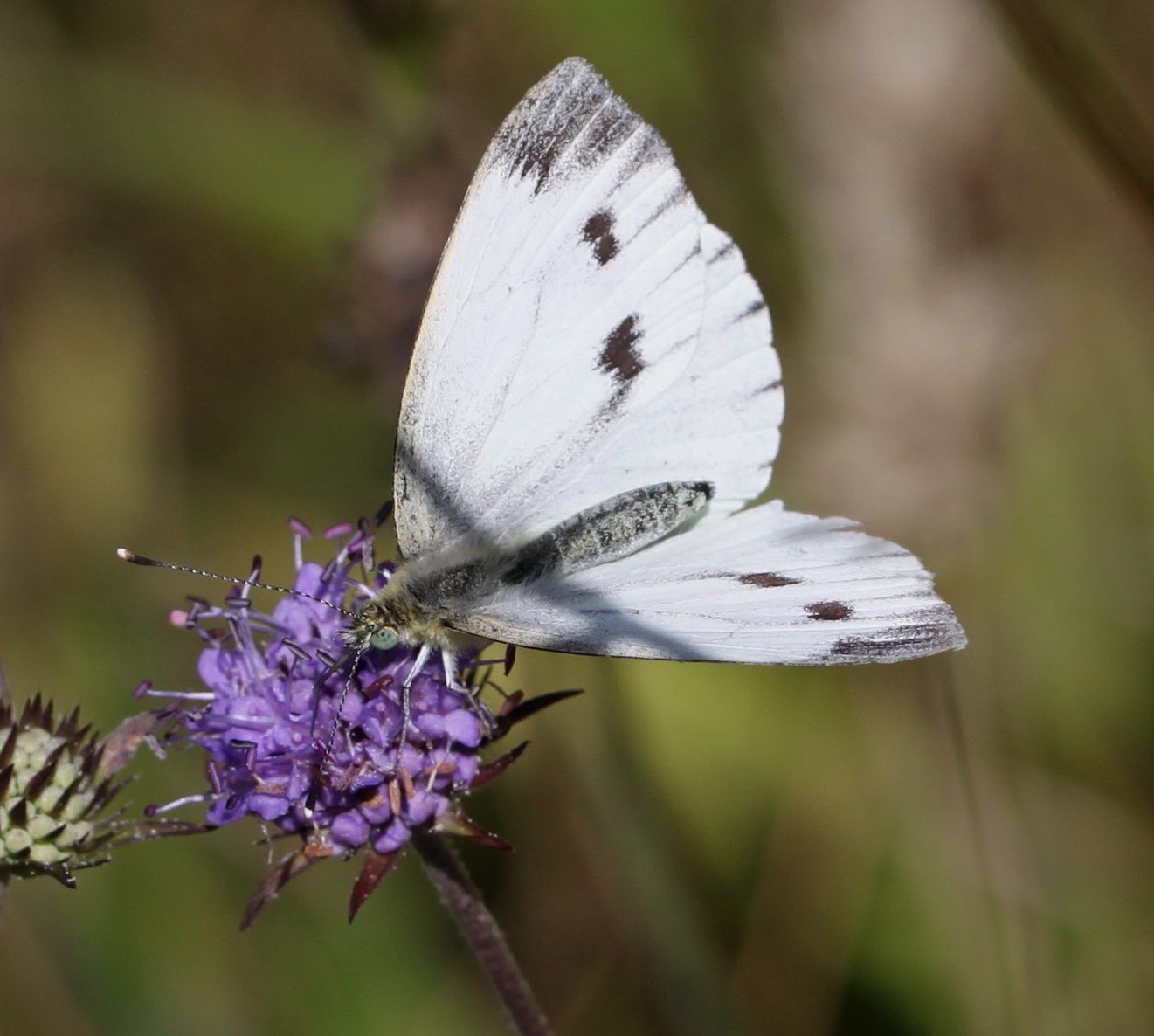
Male Large White |
|
|---|---|
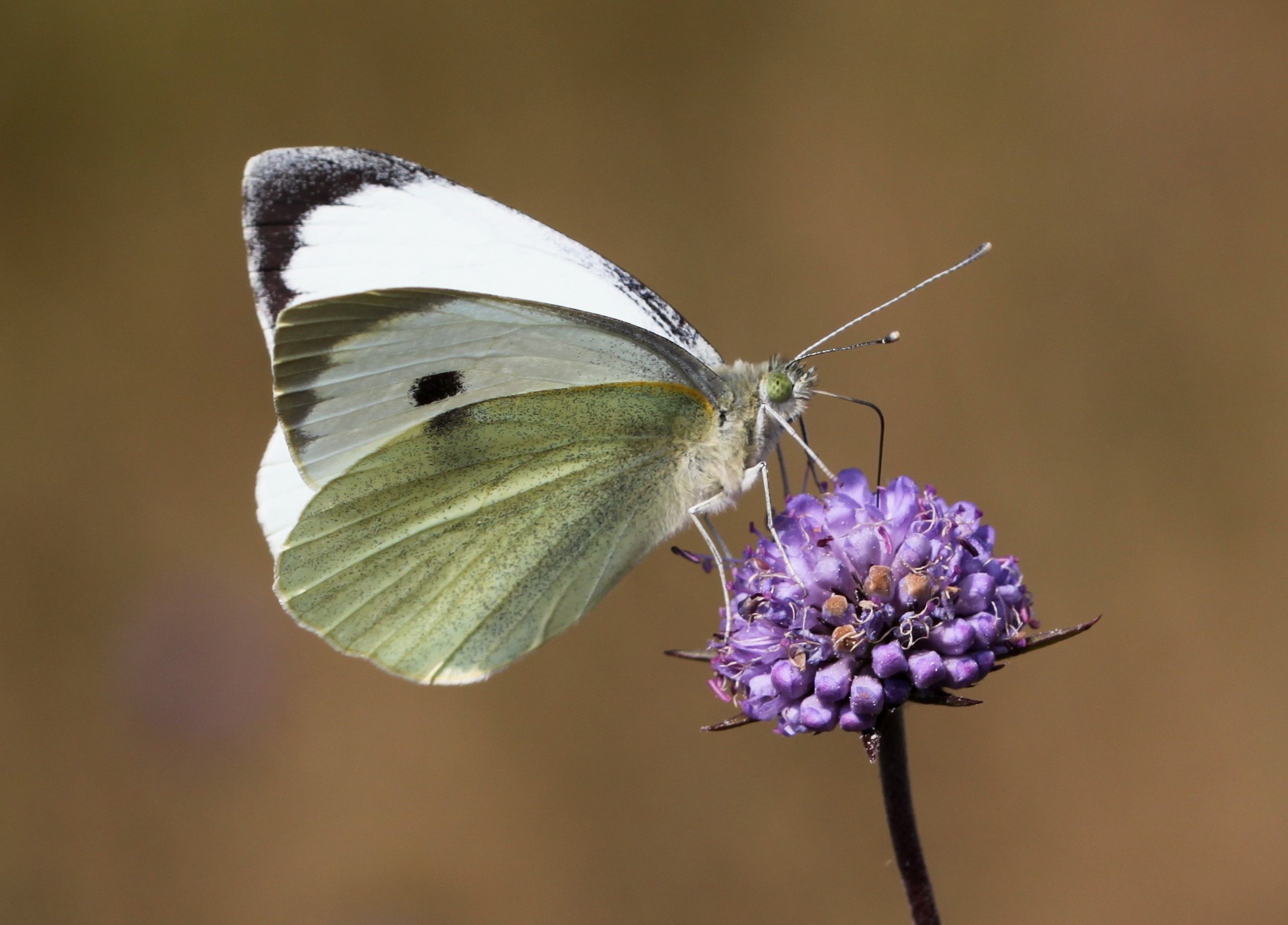
This is a large black and white butterfly (it dwarfs the flowerhead of Devilsbit Scabious). The left upperside forewing is a "brilliant white" with an extensive large black patch on the wingtip. There is also a large patch of speckled grey/black on the leading edge adjacent to the body. These features tell us it a Large White and since the upperside forewing has no black spots, it must be a male. |
|
Male Large White |
|
|---|---|
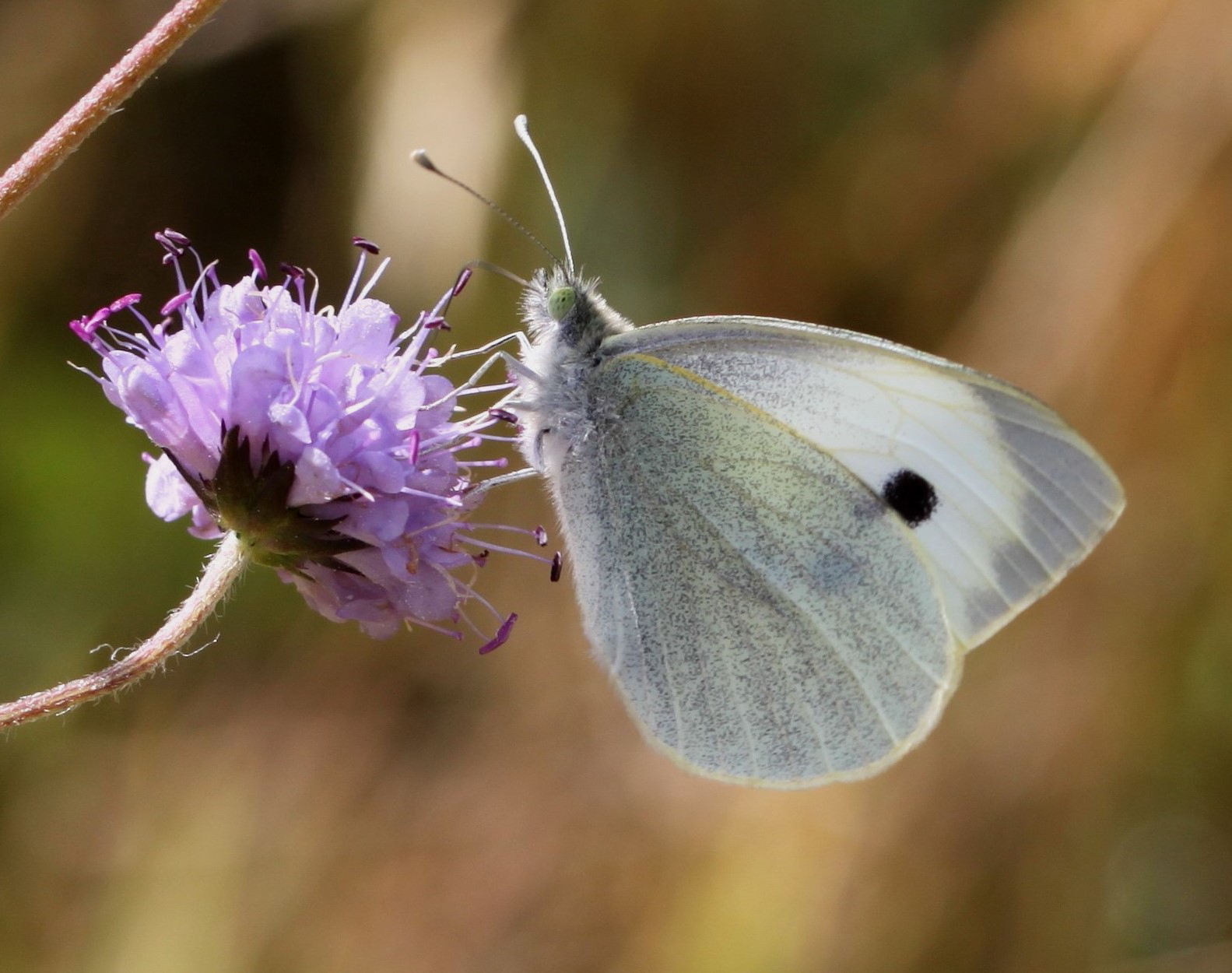
The large dark patch on the forewing tells us this is a Large White. We cannot see any black dots "through" the forewing and therefore we can be confident this is a male Large White. The undersides of a Large White are similar for both sexes. The hindwing is a lovely mix of a background green with speckled grey spots. |
|
Male Large White |
|
|---|---|
The sun is shining through this butterfly, and the hindwing is a speckled pale grey with a tinge of green. The markings are similar to the previous one and it is also a male Large White. |
|
Female Large White |
|
|---|---|
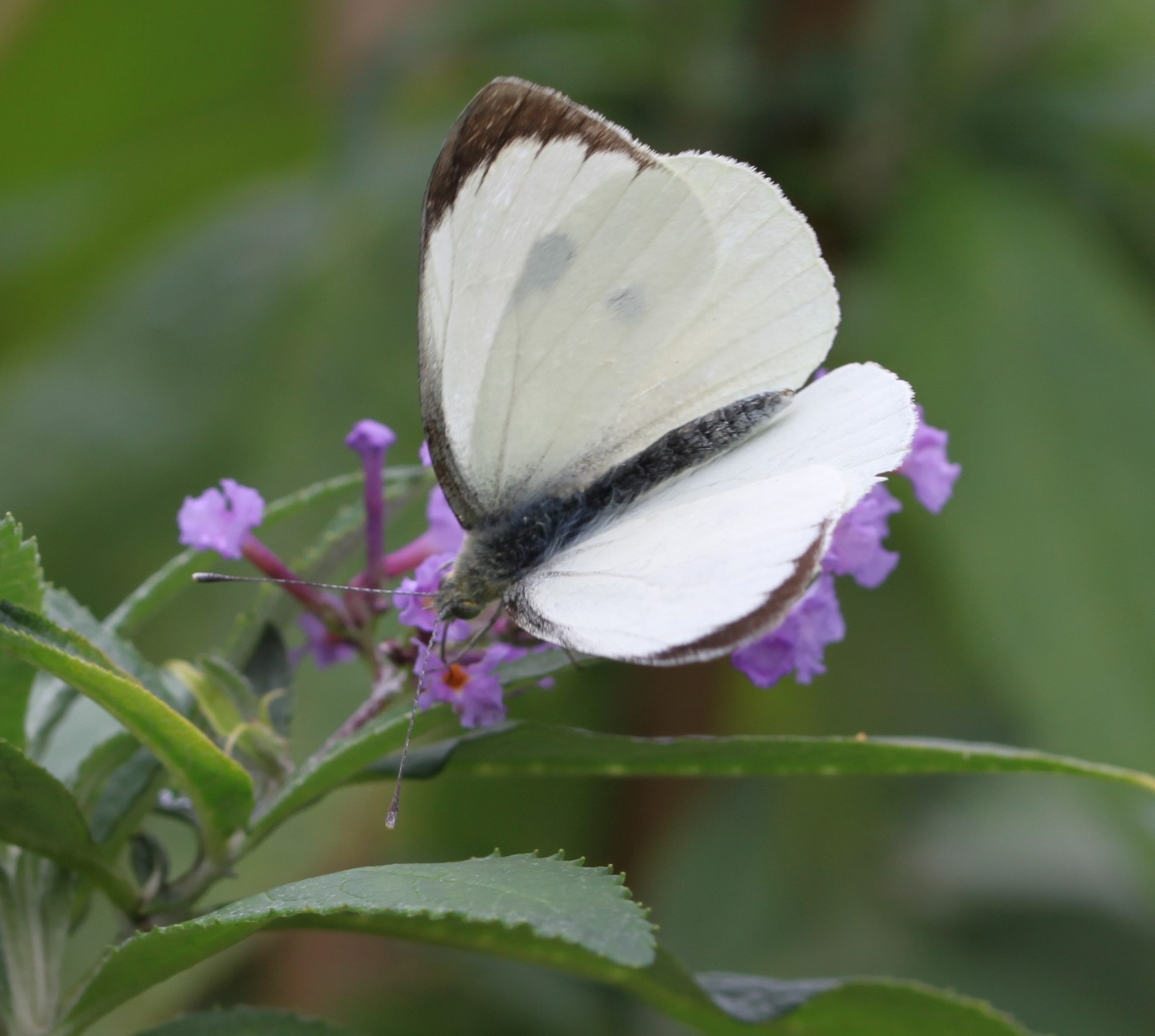
The same ID features apply but this is a much lighter individual. The most important ID feature is the large dark patch on the tip of the forewing. We can see three large dark marks "through" the hindwing and therefore I am confident it is a female (the male has a maximum of two dark marks, and the marks are usually much smaller). |
|
The Small White is another common butterfly in Sussex. It is a resident species, but in late summer its numbers are boosted by migrant flocks, which can be spectacularly large.
In flight it has a jerkier action compared to a Large White and as it is generally quite a lot smaller it flaps its wings more quickly, perhaps twice as fast.
It too is a wanderer, the male flying far and wide in search of a female and the female flying far and wide, seeking out suitable larval foodplants. In the context of north-west Sussex woodlands, the principal foodplant is likely to be Garlic Mustard.
The size of a butterfly does help with ID but as there can be an overlap in size between Small White and Large White, it is the tip of the forewing which is the best ID feature. Both sexes have a small grey patch which is confined to the very tip of the forewing. The first brood has a pale grey tip, whilst the second brood usually have a darker grey, or blackish grey, wingtip.
Female Small Whites have two black dots on the upperside forewings, whilst the male has a single faint spot in the first brood (this is sometimes absent) and a larger, darker spot in the second brood.
The black dots on the forewings are very variable in size and shape.
First brood female |
|
|---|---|
Concentrating on the upperside right forewing, the background colour is white, there is a small grey patch, which is confined to the wingtip, and there are two black spots in the middle. The most important ID feature is the small grey patch on the wingtip. These characteristics tell us this is a female Small White. As the wingtip is a pale grey, it is likely to be a first brood individual. |
|
First brood male |
|
|---|---|
In the field, it is not the prettiest of butterflies, but in a photograph it looks rather better, and the hindwing is an attractive green with speckled grey. The small grey patch on the tip of the forewing confirms it is a Small White. We have no view of the uppersides (to check for black spots) but the single, small black spot on the underside of the forewing suggests (to me) that this is a male. The pallor of the grey patch on the wingtip points towards a first brood, and as this butterfly is nectaring on White Campion (mostly in flower, in the month of May) that rather confirms the brood status (photo - 08/05/2018). |
|
Second brood female |
|
|---|---|
This patch on the wingtip is much darker, but it is still confined to the tip, and it doesn't extend very far along the wing edges. There are two large black dots in the middle of the forewing. These are the ID features of a female Small White, and as the markings are very dark it is likely to be a second brood individual (photo - 26/08/2022). |
|
Second brood male |
|
|---|---|
There is a small grey patch, confined to the wingtip, and a single black dot on the forewing, and this tells us it is a male. The markings are dark grey, which suggests a second brood individual, and as it is nectaring on Devilsbit Scabious this confirms that it is late summer (photo - 20/08/2020). |
|
Second brood male |
|
|---|---|
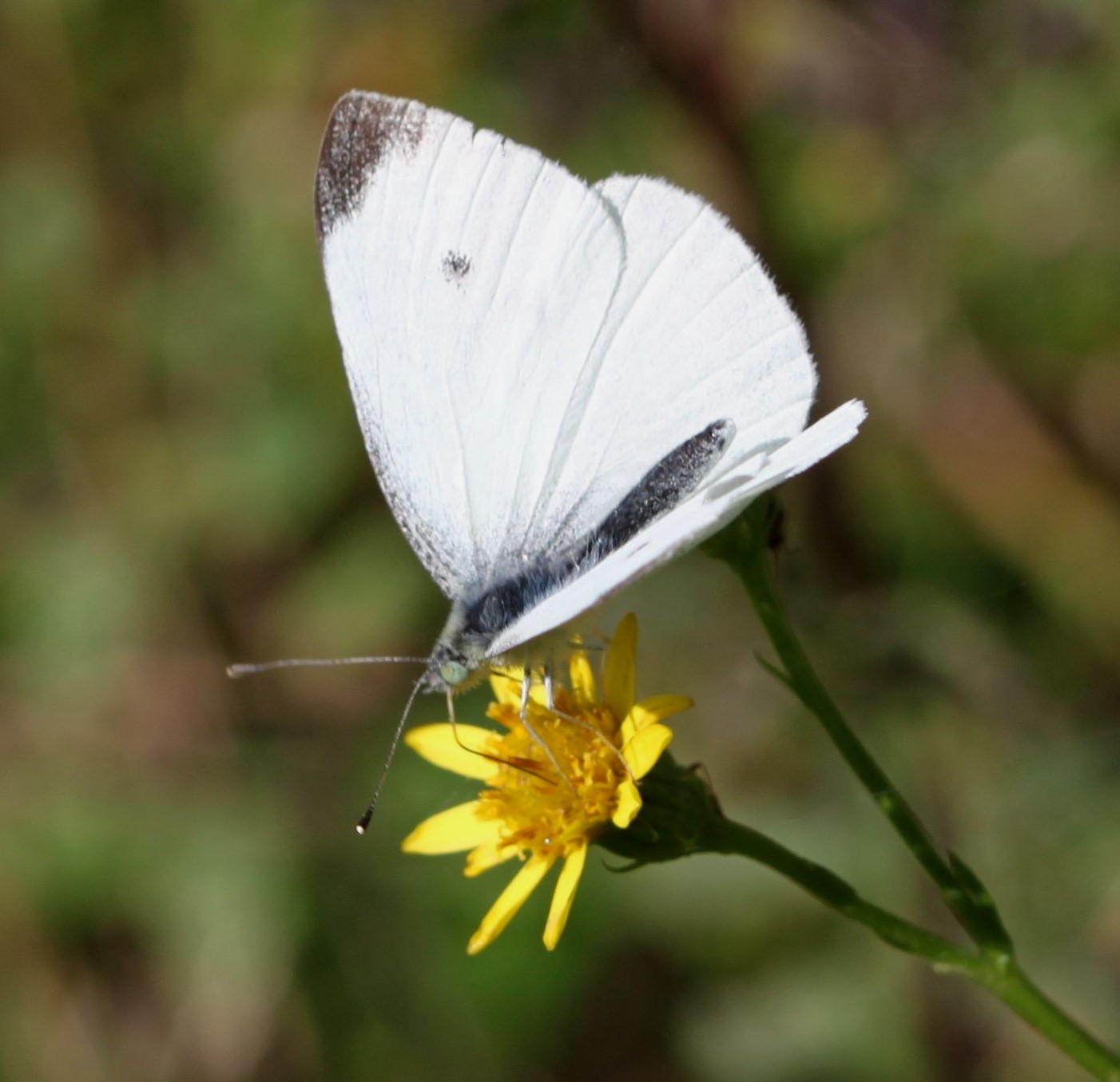
There is a very small dark grey patch, confined to the wingtip, and a tiny black dot on the forewing. The darkness of the grey patch suggests a second brood male, whilst the tiny black dot on the forewing suggests a first brood male. It just goes to show how variable Small Whites can be! (photo – 19/09/2025) |
|
With closed wings |
|
|---|---|
When the wings are closed, distinguishing between Small White and Large White can be difficult. In this photograph there is a slither of the right forewing, upperside that is visible, and this is very helpful. The patch on the wingtip is a pale grey, and it appears to be confined to the tip. This points towards a Small White. Sometimes secondary ID characteristics can come to the rescue, and if we look at the leading edge of the right forewing, adjacent to the body, we can see a little bit of mottled grey, and not the dense black which we usually see in Large Whites. All in all, I am confident this is a Small White. |
|
Green-veined White is a dainty butterfly, with a weak fluttering flight. It is another wandering white butterfly species and is a fairly common species in the woods of north-west Sussex, where the main larval foodplants are likely to be Garlic Mustard, Cuckooflower and Hedge Mustard.
The green veins are an optical illusion, and depending on the position of the sun, and where we are standing, our eyes may see these veins, as green or grey. Regardless of the colour, it matters not, for if we have a good view of the undersides, it is the “prominence of the veins” that makes it a straightforward ID. As for the uppersides, the females are more heavily marked compared to the males, and the second brood are more distinctive, more heavily marked, compared to the first brood.
Females have two spots on the upperside forewings, whilst males have one spot, or none at all.
As for Large White and Small White, it is the dark markings on the wingtips that we must scrutinise carefully. A Green-veined White has a grey patch on the tip of the forewing, and this grey extends along the rear edge, as a row of triangles, which gradually become smaller in size.
The underside "green veins" |
|
|---|---|
A Green-veined White probably doesn't come in our top ten prettiest butterfly species, in Sussex, but occasionally it surpasses itself, as in this photograph. It has prominent green veins, and so it is an easy ID. |
|
First brood male |
|
|---|---|
This first brood male is almost completely white. It could be confused with a Small White but the grey marking on the wingtip differentiates between the two species. Small White has a grey patch that is confined to the wingtip, whilst Green-veined White has an extension of this grey along the rear edge, with a row of triangles, which gradually become smaller in size. Despite reducing the brightness in this photograph, it is still a struggle to see these faint grey triangles. |
|
First brood female |
|
|---|---|
This first brood female has very prominent veins and the markings on the wingtip are also more obvious. Note the triangular markings and that they reduce in size, away from the wingtip. Females have two black dots in the middle of the forewing, but we cannot see that ID feature in this image. This female is feeding on Honesty, and in my garden this species also lays its eggs on this plant. |
|
Second brood male |
|
|---|---|
This butterfly has obvious green veins and therefore the ID is easy. It has one black dot on the forewing and therefore it is a second brood male. The grey markings on the wingtip are interesting. They are darker compared to the first brood male shown above, but there are only two small triangles on the rear edge. These triangles usually reach halfway along the rear edge but as we can see in this image, that isn't always the case. |
|
Second brood female |
|
|---|---|
When I spotted this butterfly in the garden, it was so big I thought it must be a Large White. Then I saw the green veins and realised it was an enormous Green-veined White. It just goes to show that whilst the size of a butterfly does helps us with ID, it is not the be all and end all. The abdomen tells us it is a female, but that aside, it is very well-marked and has two large black dots on the forewing. In this individual, the triangles at the rear edge of the forewing, are more like church steeples! |
|
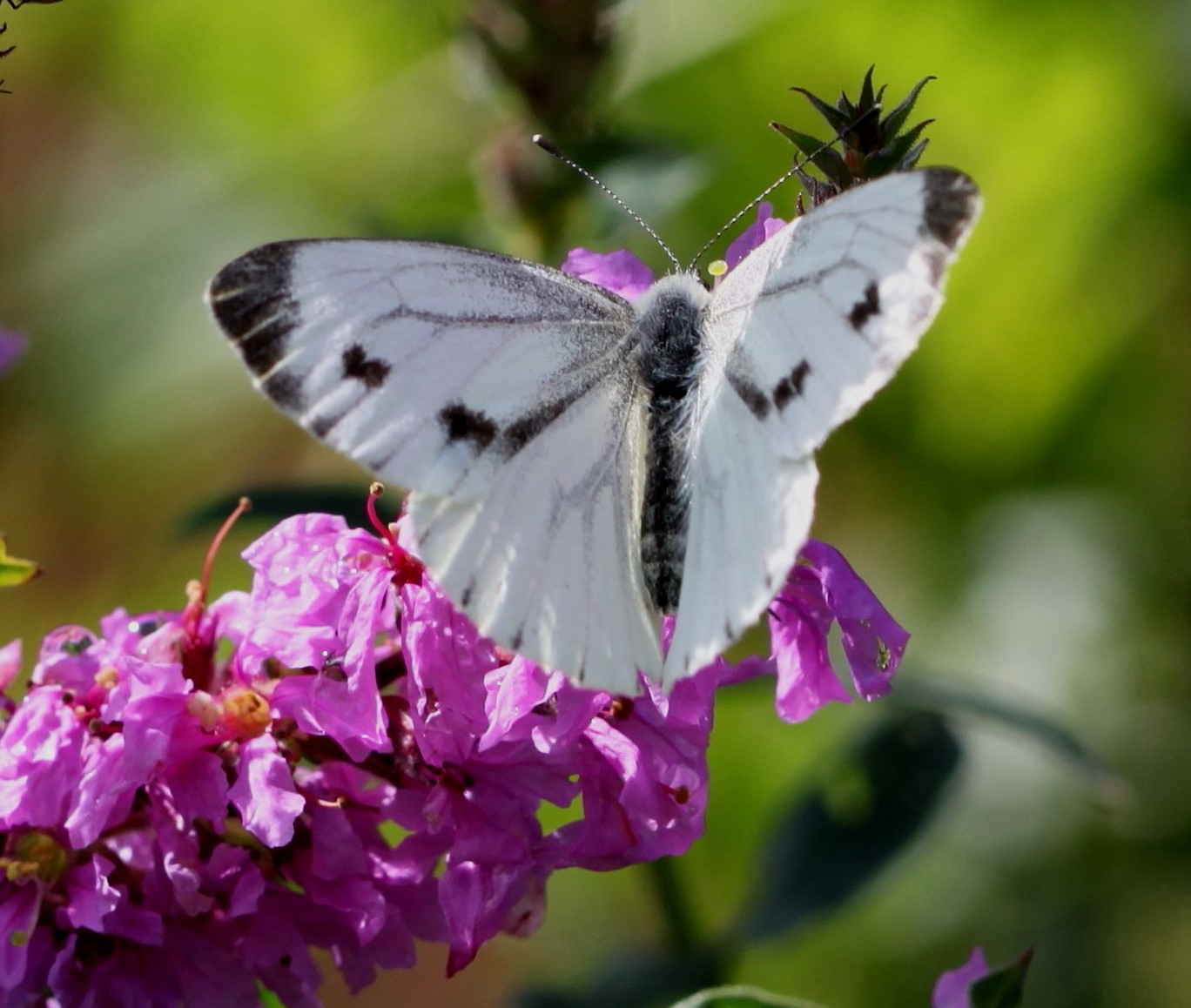
Second brood female |
|
|---|---|
The most flamboyant female GVW I have ever photographed; it really is a stunning insect. The markings on the wingtips are more black than grey, and they extend along the rear edge of the forewing as a row of triangles. There are two large black dots on the forewings and lots more dark markings, besides. Once again, it shows the great variety in the insect world. They do not all look the same. This one was feeding on Purple Loosestrife. |
|
The Orange-tip butterfly should be included in this guide, as it also shares the same woodland tracks and rides as Wood Whites. A Male Orange-tip has orange on its wings and therefore identification is very straightforward. A female could be confused with both Green-veined White and Wood White, especially when it is flying “low and slow” looking for its larval foodplants.
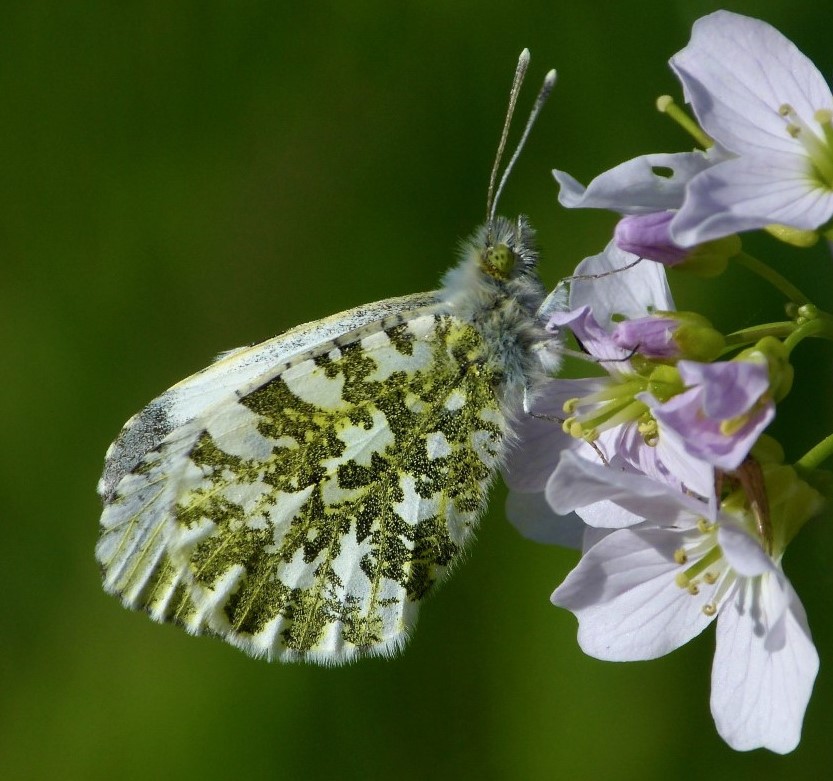
The uppersides of a female is rather similar to a Wood White. The forewings are off-white and it has grey wingtips, whilst the hindwings are mottled with pale grey. The main distinction is the underside hindwing, which is mossed green on a very white background. Once we have a clear view of the underside hindwing the ID should be straightforward
Male Orange-tip |
|
|---|---|
Male Orange-tip perched on Bluebells. No other UK butterfly has these orange-tipped wings and therefore the ID is easy. |
|
Female Orange-tip |
|
|---|---|
Female Orange-tip at rest. Could be confused with other white butterfly species. The uppersides are mostly white with grey wingtips. The grey and white edging of the wingtips is a distinctive feature. |
|
Female wingtips |
|
|---|---|
An older female with less distinct "grey and white" edging of the wingtips. This butterfly is nectaring on Dames Violet. |
|
Female nectaring |
|
|---|---|
A female nectaring on Greater Stitchwort. The undersides of the wings, show well. On the hindwing we can see the mossed green on a very white background. The "dark and white" edging of the wingtips also show well. |
|
Female perched |
|
|---|---|
A female perched on Cuckooflower. A good view of the hindwing, which shows the characteristic mossed green on a white background. |
Photo by John Williams |
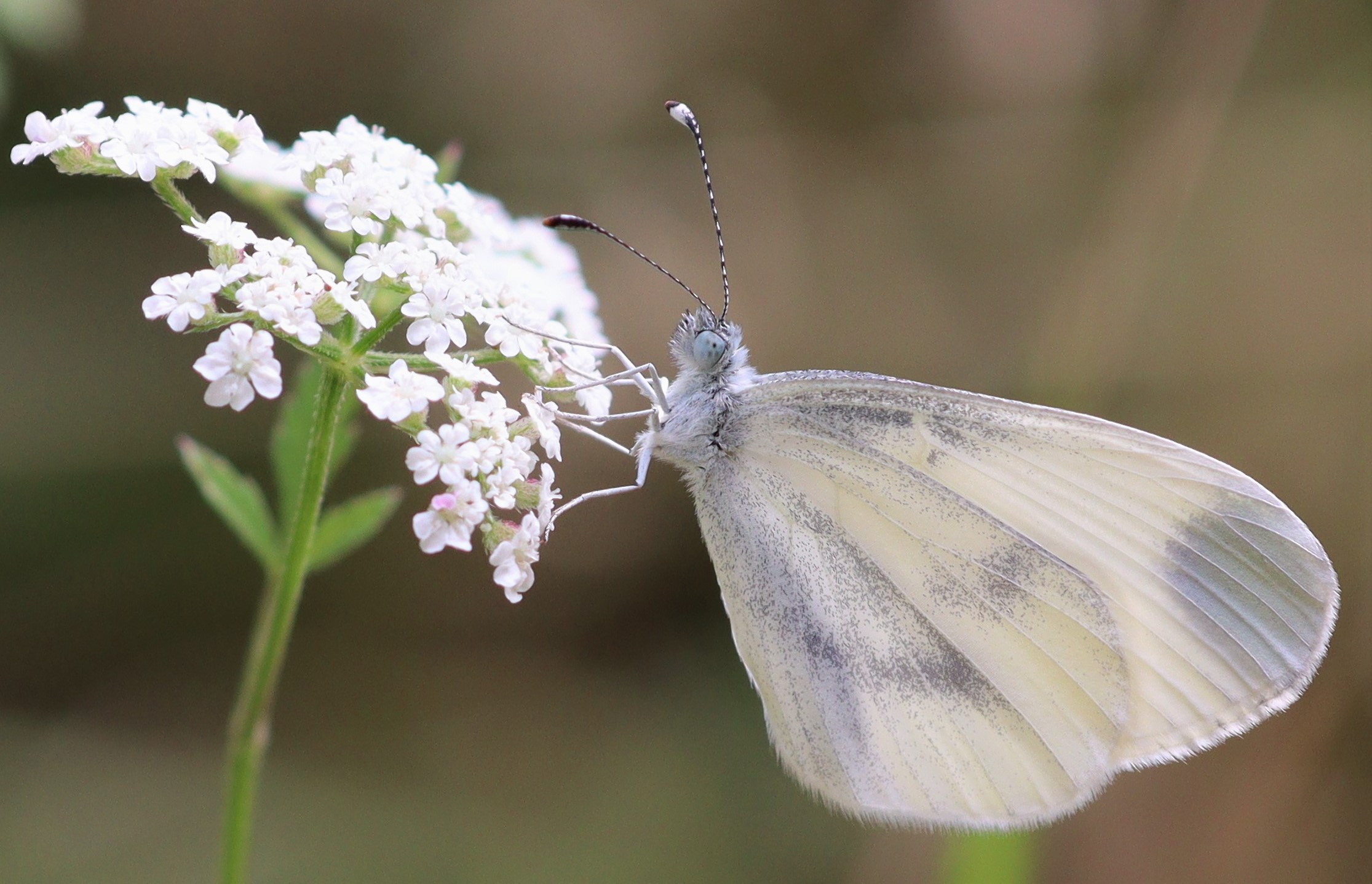
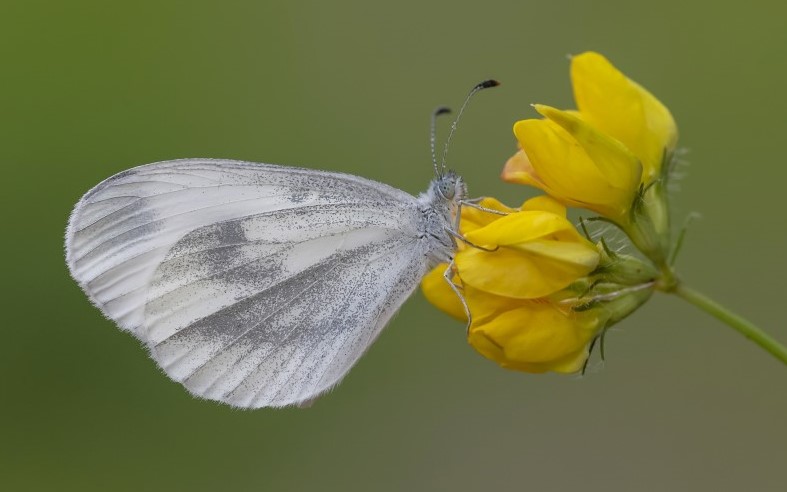
Wood White is the smallest and daintiest of our UK white butterflies and in recent years it has been a very rare insect in Sussex. In 2025 that all changed, when it was found in several of our north-west Sussex woodlands.
In many ways it is a relatively easy ID for it has several very helpful characteristics. The first is its sedentary nature, the second is the amazingly slow flap of its wings, and the third is the closure of its wings, as soon as it perches.
Large Whites, Small Whites and Green-veined Whites, are wanderers: here one moment and gone the next. Wood Whites do occasionally wander (how else would they be re-colonising some of our West Sussex woods), but generally they are sedentary and stick to the same stretch of sunny woodland ride for the duration of their lives. They are very obliging insects, for with a careful approach they tend not to move away, and seem quite content to be photographed, any number of times.
Their wing flaps are so slow, it is not difficult to make out their dark wingtips, as they flutter a few feet, from one perch to another.
If it isn’t very warm, most butterflies (including the three white species already discussed) will open their wings, either partially or fully, depending on the prevailing conditions. Wood Whites don’t do that, for they habitually close their wings as soon as they land.
First brood males have prominent dark grey wing tips, whilst second brood males have dark grey/blackish wing tips. Both first and second brood females have pale grey wing tips but compared to the males, the colouring is much more subdued.
Another distinction between the two sexes are the antennae tips. The very tips are reddish-brown in both sexes, but the male also has an obvious white patch behind this reddish-brown tip.
The second brood is less numerous than the first and both sexes are smaller compared to the first brood.
The usual larval foodplants are Bitter Vetch, Meadow Vetchling, Tufted Vetch and Birdsfoot Trefoil.
First brood courting pair |
|
|---|---|
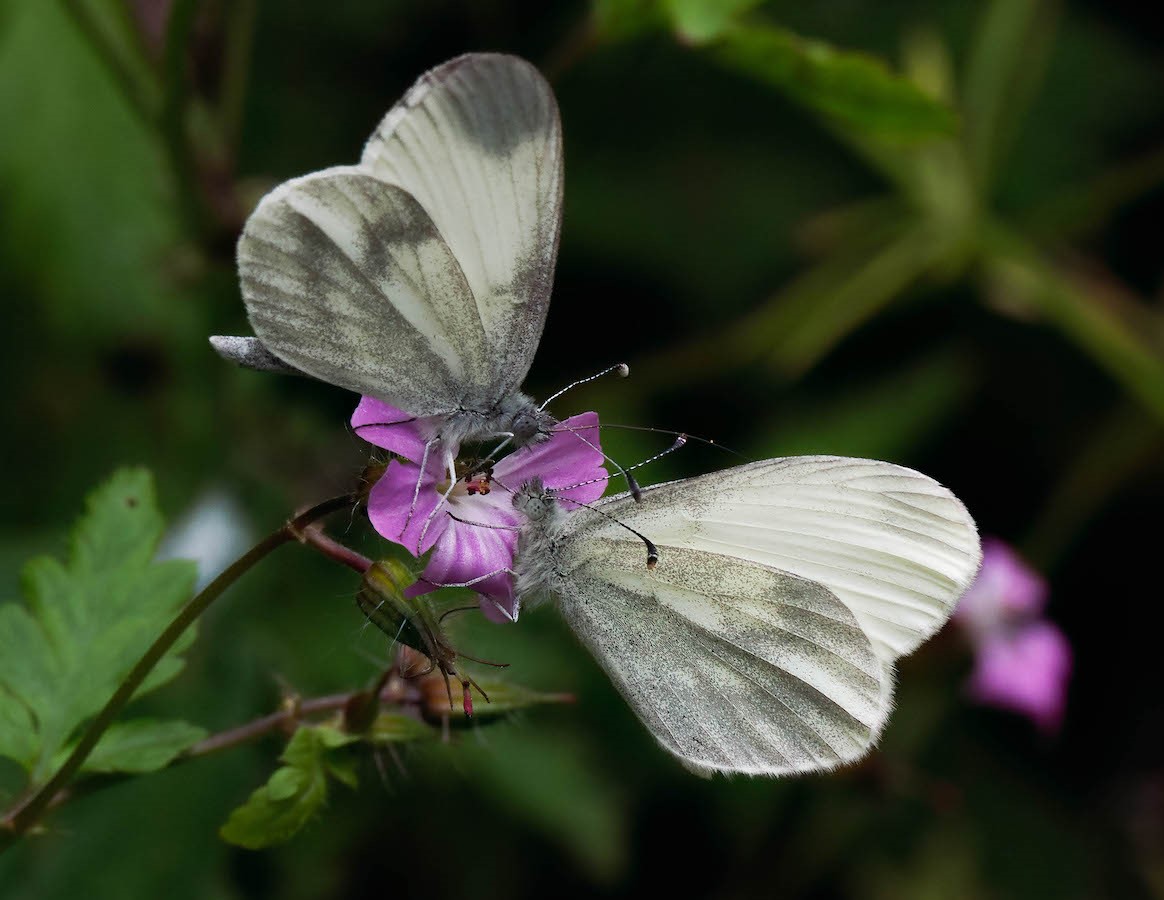
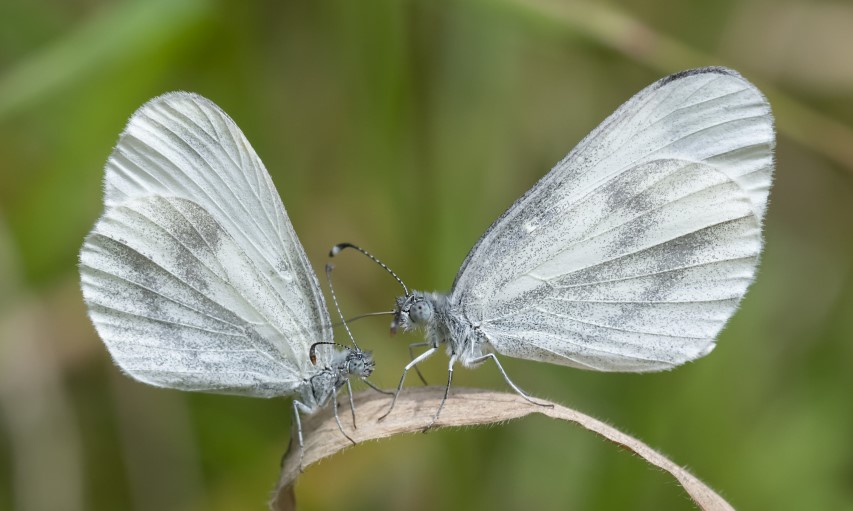
This lovely photograph of a courting pair clearly shows the differences between the male on the left and the female on the right. Unlike the three white species described so far, it is the male that has the bolder markings, and we can see the dark tip to the forewing and the dark mottled grey/green markings of the hindwing. By contrast, the markings of the female are much more subdued. She does have a dark wing tip, but it is a smaller and pale grey. |
Photo by Graham Hubbard |
First brood female |
|
|---|---|
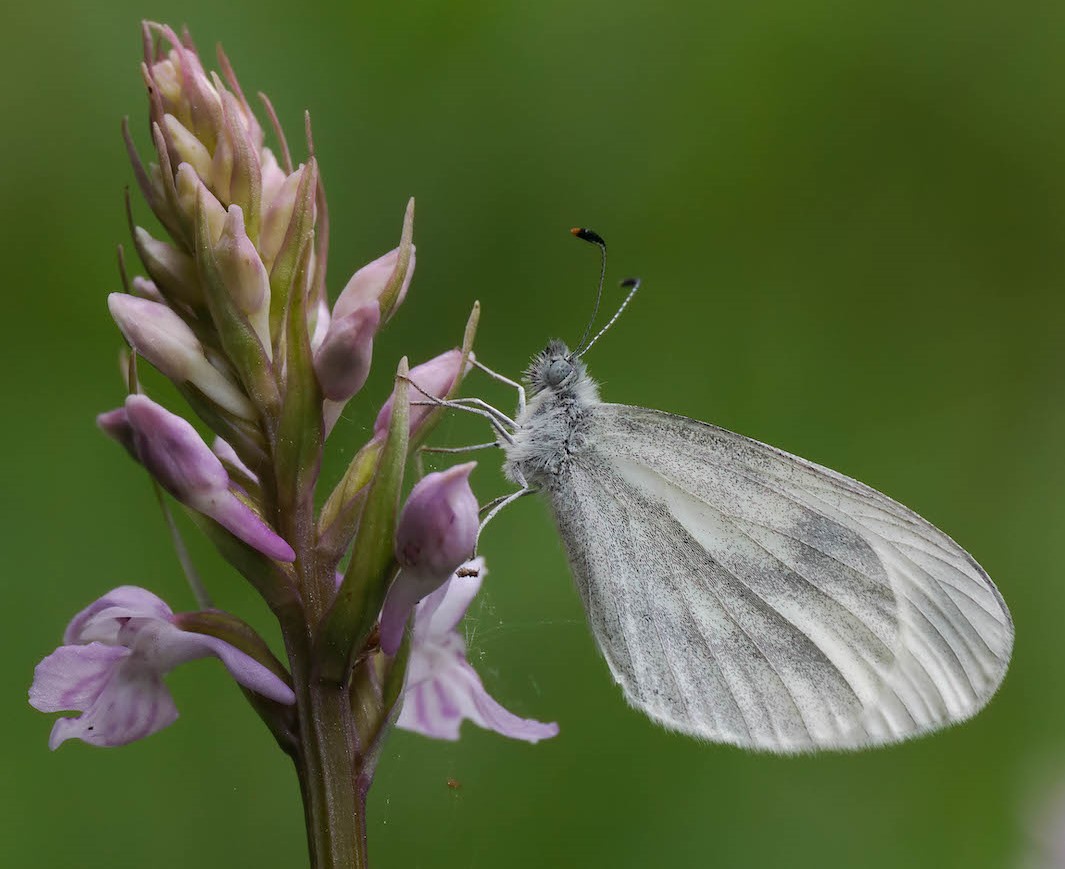
The oval shaped wings are very characteristic of this species, with the wings of the female, more rounded, compared to those of the male. As there is no obvious black wingtip, I think this one is a female. She is perched on Common Spotted Orchid. |
Photo by Graham Hubbard |
First brood male |
|
|---|---|
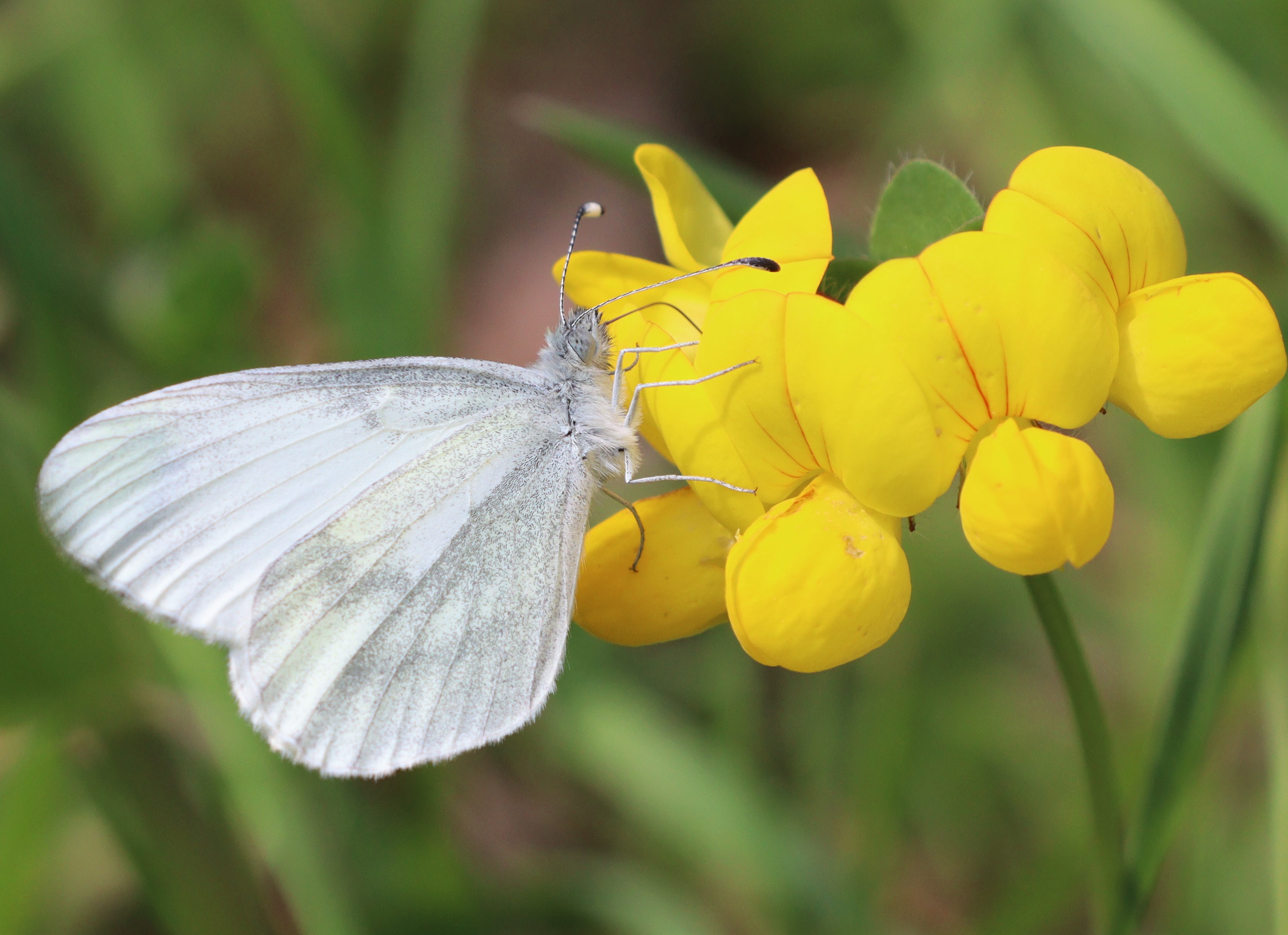
A male nectaring on Birdsfoot Trefoil, one of the Wood White larval foodplants. The white patch on the left antennae tip is clearly seen, and this identifies this butterfly as a male. |
Photo by Dave Brown |
Second brood male |
|
|---|---|
A male perched on an umbellifer. The dark wingtip of the upperside forewing shows through very readily. Note the oval shaped wings. |
Photo by Dave Brown |
Second brood female |
|
|---|---|
This female is perched on Meadow Vetchling, another one of the larval foodplants. The absence of the white patch on the antennae tips, identifies this butterfly as a female. |
Photo by Bob Eade |
Second brood courting pair |
|
|---|---|
We will finish with another courting pair, with the male on the right. The male's wings are very slightly separated, and we can see a slither of the dark wingtip. The female's wings are more rounded, compared to the male. |
Photo by Bob Eade |
| Feature | Large White | Small White | Green-veined White | Orange-tip | Wood White |
|---|---|---|---|---|---|
| Size | Large or Medium | Medium or Small | Medium or Small | Small | The Smallest |
| Underside Hindwing | Green with grey speckles | Pale green with tiny grey dots | Prominent green or grey veins | Mossed green on white background | Grey patches on off-white |
| Wingtip Pattern | Extensive black on tip, extends along edges | Small grey patch confined to tip | Grey with triangular marks down rear edge | Grey tip, with white and grey edging | Dark on males (visible through wing) |
| Wing Shape | Angular | Angular | Fairly angular | Rounded | Very rounded, oval |
| Flight | Powerful, languid | Jerky, rapid | Weak, fluttering | M: very fast and jerky F: slow fluttering flight (when egg-laying) |
Very slow, exaggerated flaps |
| Behaviour | Wandering | Highly sedentary | |||
| Wing Position | Often partially open | Always closed | |||
| Habitat | Widespread | Woodland rides/glades only | |||
Male : Dark (black) wingtip visible through hindwing. Bolder markings overall. Wings less rounded.
Female : Subdued markings. More rounded wings.
| Size | Behaviour |
|---|---|
|
What is its size? Wood White is our smallest white butterfly species. They are never large. So, we only have to think about Small White, Green-veined White, Wood White and female Orange-tip (male Orange-tips are so distinctive, we can forget about them) If this white butterfly is small we can disregard Large White. Even when Large Whites are small, they are still far too large to be confused with a Wood White |
Is it wandering or is it staying put? Small Whites and Green-veined Whites do not usually remain in the same spot for more than a minute or so, and then they are away. Even an egg-laying female will deposit an egg and move on, often a hundred metres away, a minute or two later. Wood Whites are highly sedentary. Any small white butterfly that is hanging around the same small area (for say 5-10 minutes) is a candidate for Wood White |
| Flight characteristics | On perching |
|
If it has a weak - looking flight action, then Green-veined White, Wood White, egg-laying Small White and egg-laying Orange-tip are all candidates. The males of both Large White and Small White have powerful flight actions. Egg-laying white butterflies fly very slowly and are found close to the ground (looking for suitable foodplants). The wing beats of a Wood White are very slow, indeed. On a different level to the other two species. Think Small Heath. A weak flight action and it doesn’t fly more than a few metres before it settles again, for a rest. Very strong parallel between Small Heath and Wood White! |
Once it has perched, a Wood White immediately closes its wings. The other species may or may not do the same, depending on the temperature. Think Green Hairstreak. Think Grayling. Some species never show their uppersides, except when they are flying. Within seconds of landing, if the white butterfly has partially-open wings, then it is not a Wood White |
💡 Quick Tips:
Small White = pale green with masses of tiny grey dots
Green-veined White = green or grey prominent veins
Wood White = grey patches on an off-white background
Female Orange-tip = mossed with green on a very white background
These underside hindwings are very different for these species. Field workers need to memorise the differences.
I remember the Wood White pattern as “waves of dark rainclouds” scudding across the sky. No other UK butterfly has similar colours and pattern.
❌ “It’s small, so it must be a Wood White” → Small Whites and Green-veined Whites can be equally small
❌ “I saw it in a wood, so it’s a Wood White” → Small Whites and Green-veined Whites are common in woodlands too
❌ “It has a dark wingtip” → ALL white butterflies have some dark markings on wingtips
✅ Focus on the UNDERSIDE HINDWING PATTERN first - this is your most reliable field mark!
Our white butterfly species share many similar characteristics and can be tricky to identify, but Wood Whites do offer a number of clues that should help us achieve a correct ID.
They live in self-contained colonies, which means they are relatively sedentary. They can usually be found on the side of a sun-lit, track or ride, in or around a woodland. If we inadvertently disturb one, it will probably only fly a few metres before settling down again.
Find the larval foodplant, find the butterfly. We will only find the larval foodplants in sun-exposed areas, and if we cannot locate these plants, then we are unlikely to find any Wood Whites. We need to head for the sunny rides and glades where there is fairly low vegetation and the foodplants are plentiful.
Wood Whites fly with exaggerated, slow wing flaps and when they flutter from one perch to another there is often an opportunity to see the wing markings, whilst they are actually flying. When perched, we can see the very obvious very rounded wings, and a hindwing that is mottled green or grey. If it’s a male, the upperside dark wingtip, should be visible “through” the hindwing. On perching, the wings are immediately closed, which contrasts with other white species, which often hold their wings partially open when they are resting or feeding.
Dear members, please join in this search for Wood Whites, beginning in the spring of 2026!
Martin Kalaher 24/01/2026


.JPG)
.JPG)
.JPG)
.JPG)
.JPG)
.JPG)
.JPG)
.JPG)
.JPG)
.JPG)
.JPG)
.JPG)
.JPG)
.JPG)
.JPG)
.JPG)