Callophrys rubi
This species can be fairly common, or occasionally very common, in a few isolated pockets of the South Downs, especially where shrubs are plentiful. Elsewhere in the county it is thinly-spread and in some 10 km squares, very difficult to find. Even where it is present in quite good numbers it is easily over-looked, for with a backdrop of a Hazel leaf, a territorial male is extremely well camouflaged. Only when it moves is it likely to be spotted.
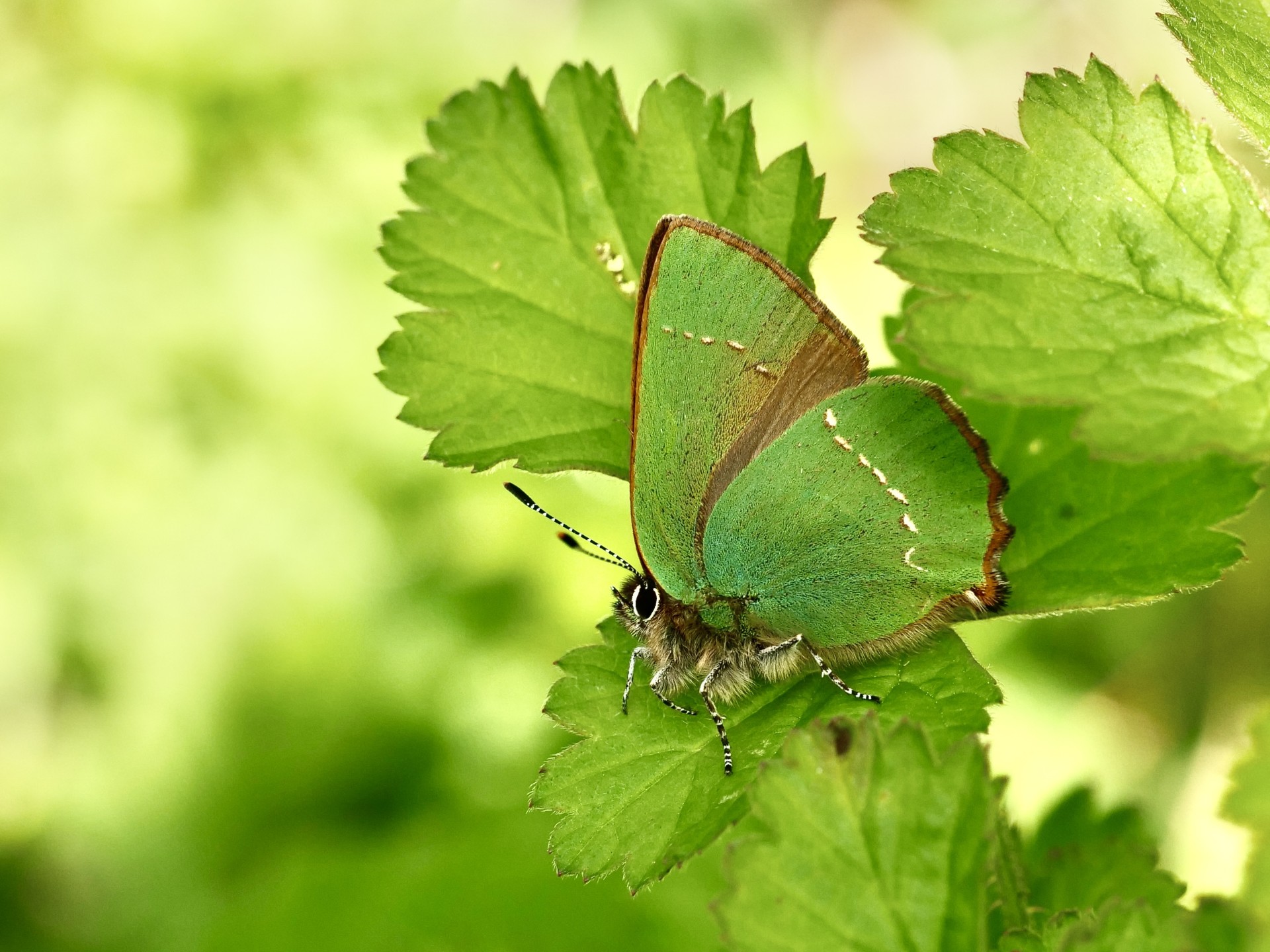
Identifying a Green Hairstreak should be easy enough as it is the only green butterfly in the UK. Typically, there are 5-6 white dashes, across the hindwing, and this is what forms the hairstreak. A few of these dashes may also be present on the forewing. Very occasionally there are no white dashes, at all.
For 2006-2024 the “average first sighting” was April 12th (range March 30th to May 3rd). Peak numbers are usually found in May, but this species may be recorded throughout June, with a few surviving into early July. Records in August 2013 at Mill Hill (Shoreham), Fore Wood (nr Hastings) and Cross-in-Hand were probably a unique partial second generation.
Green Hairstreaks usually live in small colonies in a range of habitats, which include sunny, woodland rides, hedgerows, and especially chalk downland. A few colonies can be very substantial, and at Chantry Hill, in 2014, there was a count of 100 in just one day. In one small scalloped area that was sheltered and sunny, there was a count of 25 territorial males in a row of 30 metres of Hazel bushes. They were so close to each other that any short flight resulted in relentless skirmishing, with 4-5 individuals in a single dog-fight, not unusual.
The eggs are laid on a wide variety of plants, including Birdsfoot Trefoil, Dogwood, Common Rockrose, Broom, Gorse and Bramble, to name but a few.
This species stronghold is the South Downs between the Arun Valley and Eastbourne. Colonies are generally quite small, but Chantry Hill and Devils Dyke can sometimes have populations exceeding one hundred individuals.
Territorial male Green Hairstreak – photo by David Cook

The hairstreak is limited to the hindwing – photo by David Cook

The hairstreak is even more limited, to just two white dashes – photo by David Cook
.JPG)
Female nectaring on Birdsfoot Trefoil – photo by Martin Kalaher
.JPG)
Egg-laying on Birdsfoot Trefoil
.JPG)
Egg-laying on Betony
Butterfly Conservation Green Hairstreak