.JPG)
Maniola jurtina
This is usually the most numerous butterfly species found in Sussex, although in some years this mantle is taken away by Gatekeeper. It may be found on any patch of unfertilised grassland, in discrete colonies ranging from a dozen or so, to many thousands.
In flight, a very dark male Meadow Brown could be mistaken for a Ringlet and a female Meadow Brown could be mistaken for a female Gatekeeper. When perched, and with good views, the ID should be straightforward enough.
This is a single-brooded species with a very long flight period. Between 2006-2024, the “average first sighting” was May 30th (range, May 16th to June 19th). Peak numbers usually occur in late July/early August, and for most colonies their season is over by the end of August. In this millennium, in a few sheltered, sunny locations on the South Downs, there have been regular reports in October and even November records, as on 06/11/2007, 10/11/2017 and 10/11/2018.
The caterpillars are not at all fussy and will happily eat a wide variety of medium and fine-leaved grass species. No doubt these feeding habits have contributed to this species success.
As for many of our butterfly species the numbers seen are very considerably less compared to 100-150 years ago. However, in the 21st century we can still be astonished at the bounty of nature and the sight of 3,000 Meadow Browns at Chantry Hill, in June 2017, was such an occasion
This is the most widely distributed butterfly species in the county and may be seen more-or-less anywhere there is a decent-size patch of long grass!
Female Meadow Brown nectaring on Greater Knapweed – photo by Martin Kalaher
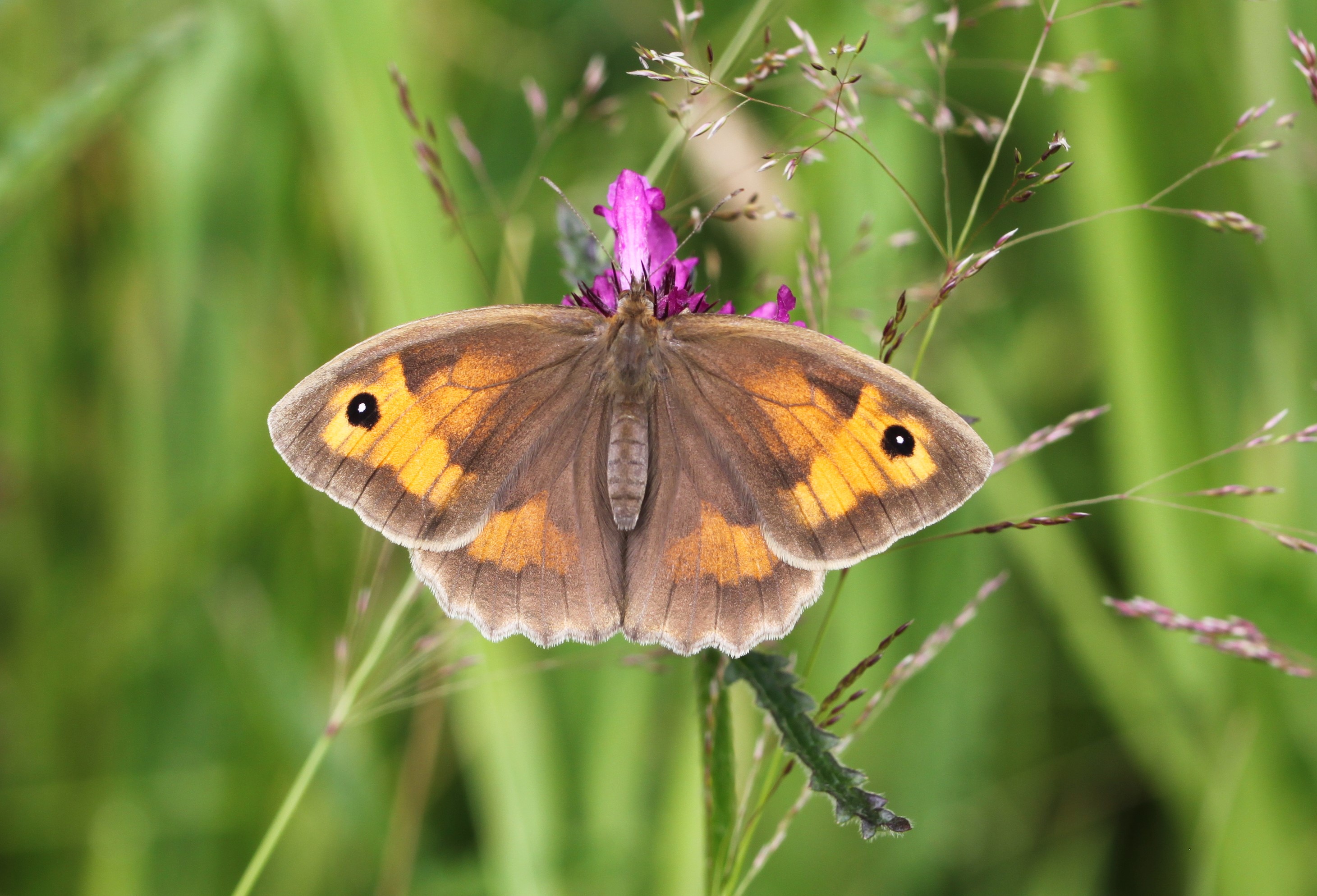
Female with open wings
.JPG)
Male with open wings
.JPG)
Male with closed wings
.JPG)
Female with open wings
.JPG)
A mating pair
Butterfly Conservation Meadow Brown